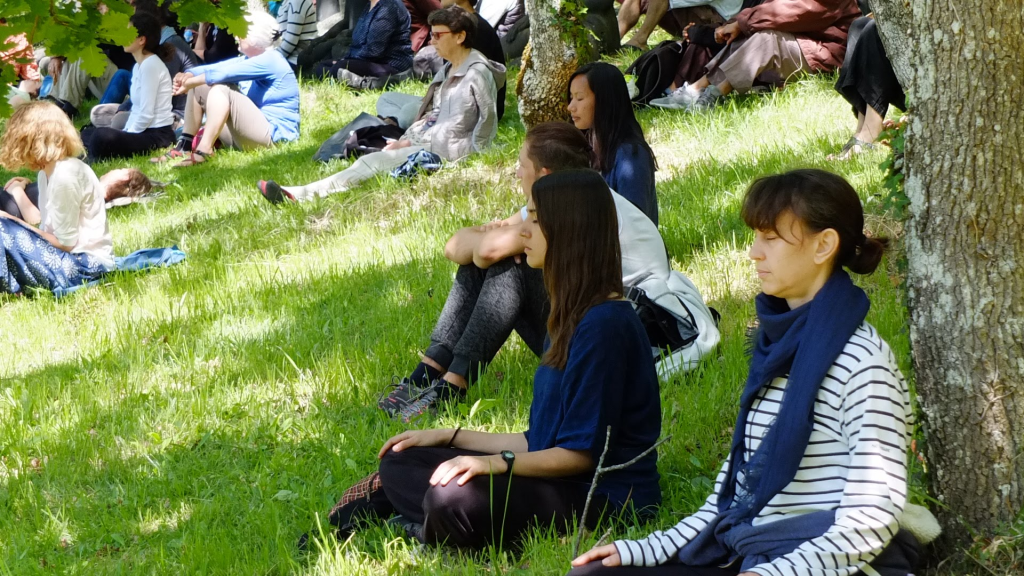
These words may evoke childood memories of listening to stories, hopefully enraptured by the storyteller. In yoga classes the same words may evoke “dread”. Whilst the teacher encourages students to settle into a period of breathing practice , meditation or just sitting. “Just sitting” – easier said than done when knees feel as if they are ‘up round our ears’; backs ache; ankles feel squished and we are using all our energy to look relaxed, to remain seated for as long as the rest of the class. Most people who sit easily in a cross legged position usually say that they have always been able to do so; that it is not something they have practiced and “achieved”. We know that some hips do not exterally rotate easily.
My advice is:
Use props, sit against the wall, change your position when needed, don’t sit for long.
This is not “wimping out” or failing to maintain a disciplined approach to yoga practice. It is sensible and practical. Yoga practice can be a valuable tool to ask yourself:
“Why am I doing this specific practice? What can I do to find comfort? Is my breath smooth,fluid?”
Why is sitting on the floor so important? It helps to undo some of the unhelpful compensatory positions the body adopts after sitting in a chair /car when the body is a right angle positon – often for many hours, day after day. When we see how easily children sit on the ground and how in many countries people sit/kneel on the ground to eat; it would seem that our our bodies are built to sit in ground-based positions.
Hip flexors can get short and tight with prolonged sitting. The effect upon the lumbar spine and hamstrings may also be pronounced:
insideyoga.blog/…/iliopsoas-the-powerhouse
Sitting cross legged (with support) helps to stretch tight hip flexors. We know that lumbo-pelvic muscles, the muscles in our pelvis and hip regions, play an important role in postural stabilisation (see getting up from the floor later)
Sitting on the floor with legs crossed/bent to one side rather than with legs long produces an inward natural spine curvature at the lower back ( lumbar lordosis.) When sitting on the floor, the lumbar lordosis is relatively low, which is closer to our natural position and posture. Sitting in a chair, especially with legs crossed at the knee, tends to rotate the pelvis back, which can increase load on the intervertebral discs and cause problems (that’s why lumbar supports help those with back discomfort). The real point is that we tend to sit in chairs in this unhelpful way for a long period of time. The answer is to move regularly – every 30-40 mins recommended, as we know.
Another reason to pratice sitting on the floor is that you have to practise getting up. The sit stand longevity test devised by Claudio Gil Araújo, a Brazilian physician and researcher in exercise and sports medicine, was published in the European Journal of Cardiovascular Prevention in 2012. The test was an indicator of aerobic fitness, core strength and flexibility- all important factors in maintaining good movement. The test also highlights the importance of balance, something that most yoga classes focus upon. The test is quite hazardous for those with poorly knees and hips, however: it does not reflect functional movement and it is not a movement mapped into our history of movement. Whereas coming up from the floor in a yoga class would often involve:
- all fours (abdominal postural tone, super body stability)
- dog pose of some sort (quad strength), plus upper body strength if one finds pure leg work in dog pose difficult and you need to push through arms
- Forward bend and rolling up to standing – kinetic chain of muscles :gluts, abdominals , spinal flexibility and those lumbo pelvic stabilisers as the body is brought to upright position.
Sitting on floor – common problems: backs, knees, hips and “pfaff“
One key factor is that you don’t have to sit cross legged to be a true yogi! Most people with discomfort will need to support their back, against. wall, for example. This would be the way to start, everything below leads from here.
Knees up : hip flexors tugging and overarching the back – sit on a soft block, cushion, blankets
- Knees uncomfortable. – not liking being flexed :
- support knees with soft cushioning so that the angle of the knee can be adjusted.
- Sit with one leg outstretched and the other leg bent, foot on the floor; move the standing foot further forward as feels right for you. Change sides as needed.
Preparation for sitting: In and out of the following moments to encourage the hip to move through your range of movement (not the teacher’s or the bendy person in the class)
- Sit with legs in front of you, knees bent and feet on the floor. Support yourself with you arms and let your knees move from side to side. Gentle internal and external rotation at the hip sockets that you take as far as is comfortable.
- Sit as above and take knees to one side so that the lower legs rests on the ground and move the other leg behind you a little. With practice you will be able to sit in a 90/90 position (one leg bent at a 90-degree angle on the floor in front of you, the other leg behind you, also at a 90-degree angle) which rotates the hip in two different ways
- Sit with one leg outstretched and cross the other leg over the long leg if possible
- Lean back to a wall or find support though your arms if sitting unaided creates tension.
MOST IMPORTANT – don’t be afraid to slouch a little. Aoife O’Meara, Musculoskeletal physiotherapist, Royal National Orthopaedic Hospital, Stanmore writes:
“if you spend all day sitting with an upright straight spine, it causes your back and core muscles to work hard and that can eventually cause pain – it’s like walking around with fists clenched all the time. Since everybody is different, there is no true neutral when it comes to posture. Instead we should prioritise changing posture very 30-40 minutes when seated and encourage mobility in the spine..…….It is safe to slouch since there is no evidence that it will cause harm when you move regularly…”
This is one of the reasons that in our yoga practice we go in and out of poses rather hold them for prolonged periods of time. As well as encouraging mobility, this maps movements in our motor cortex. With care and attention that movement will become smoother over time rather than movement rigid. With a bit of luck, sitting in class will become slightly more comfortable rather than something to dread.
 Inside Yoga